What California Educators Want from Language Arts Materials

As California prepares for the 2026 English Language Arts (ELA), English Language Development (ELD), and Spanish Language Arts (SLA) curriculum adoption cycle, decision-makers will be tasked with choosing options that will shape the classroom experience for millions of students for a decade or more. There’s no shortage of factors to prioritize when making these decisions, but one of the most important should be the voices and perspectives of educators and local education leaders.
To uplift these voices, we partnered with Californians Together to launch a statewide survey and virtual forum to identify what education leaders want and need from future ELA, ELD, and SLA materials.
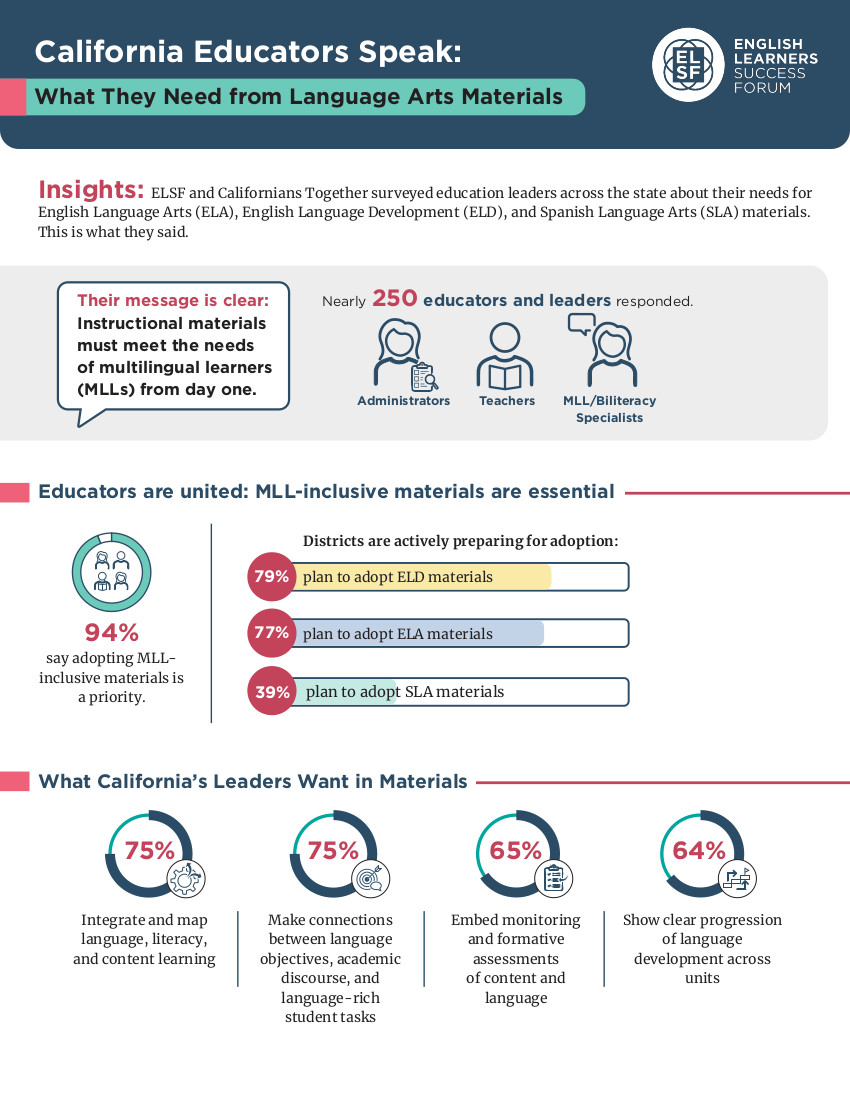
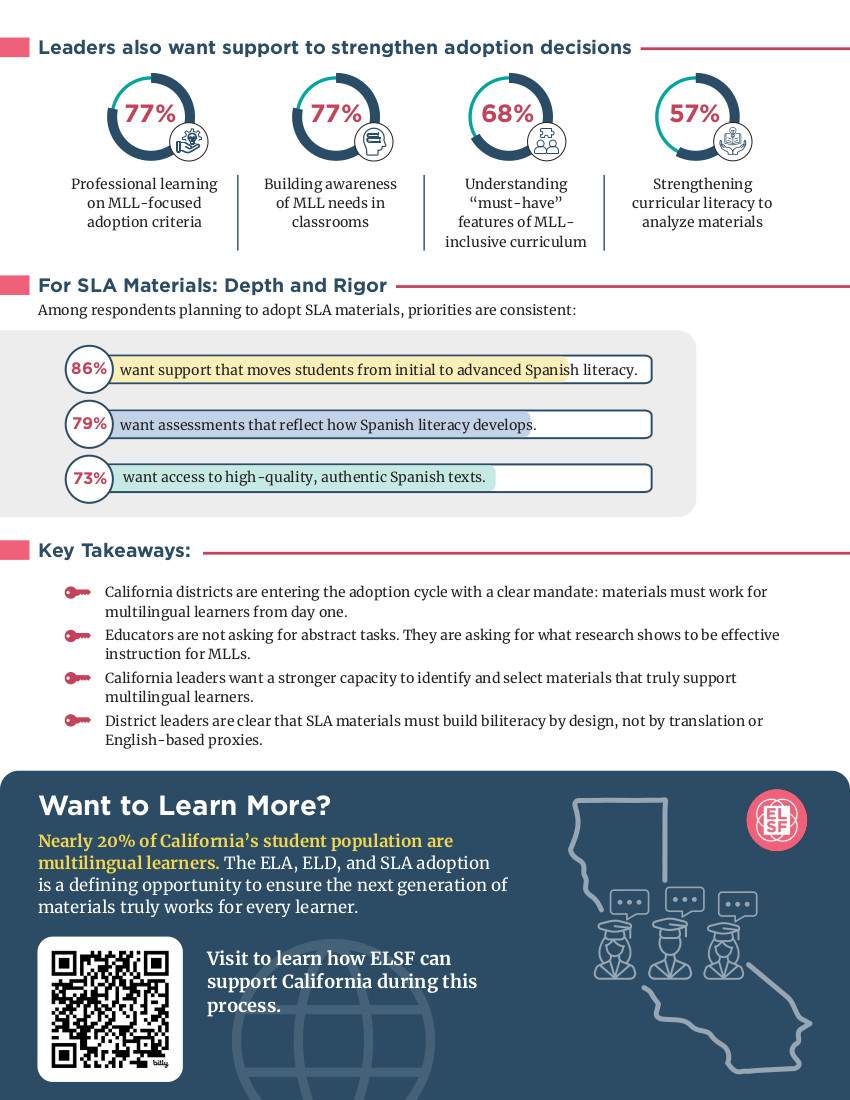
Nearly 250 California educators and leaders participated, including classroom educators, site and district administrators, and biliteracy, dual-language, and multilingual/English learner specialists.
Their perspective was clear.
Multilingual-learner responsive materials are a non-negotiable.
An overwhelming 94% of respondents say that adopting materials that ensure effective instruction for multilingual learners is a priority in this upcoming adoption process. More than half indicated room for improvement regarding their current materials, signaling a strong demand for resources that better support language development alongside literacy and content learning.

This is not a marginal issue.
Education leaders see multilingual learner-inclusive instruction as foundational to effective instruction for all students. This means supports for multilingual learners cannot be simply an add-on or specialized supplement.
The survey responses consistently reinforced three non-negotiable features that ELSF has also identified through research and field expertise.
- First, materials must include the intentional integration of mapping language development, literacy and content. This was the most cited priority among survey respondents. We can no longer treat language as separate or supplemental to core materials.
Leaders also emphasized the need for clear progression of language development across units, furthering a coherent picture that integrates language instruction throughout. - Second, materials must include clear monitoring of language objectives paired with responsive assessment. To meaningfully support students, language objectives must be aligned to tasks and materials must include formative assessments that help teachers respond to students’ language needs in real time.
- Third, instructional routines should make connections through student collaboration and academic discourse. This goes far beyond simple “turn and talks.” Materials must provide authentic opportunities for students to practice language through discussion, collaboration, and meaning-making.
Making connections through structured student-to-student interaction simultaneously supports language and content development and is much more effective than isolated speaking activities.
Throughout the survey, these features came up repeatedly. Educators are not asking for something abstract, and what they’re asking for isn’t arbitrary. Their experience in the field echoes the latest research-backed practices.


These survey results represent a call to action for curriculum decision-makers: they must demand high-quality instructional materials from publishers and they must select and implement materials that meaningfully support multilingual learners.
Hundreds of educators and district leaders expressed a desire for publishers to do more than simply adhere to compliance requirements. They’re asking publishers to develop materials that ensure the curriculum non-negotiables are embedded throughout, that meaningful language development is fully integrated from step one, and not addressed through sidebars, add-ons, and optional supports.
This moment offers publishers and school administrators and education leaders in California a powerful opportunity to transform the education landscape for the better. By elevating educators' voices and letting classroom perspectives inform their decisions, we can influence the next generation of ELA, ELD and SLA materials.
By prioritizing these voices and the research-backed guidance on what truly works, we can leverage this adoption cycle to adopt and implement materials that meaningfully and effectively support over 1.1 million multilingual students across California.
We have never been more prepared to support our multilingual students. The time is now! California’s educators know what they want in their materials. Now it’s up to curriculum decision-makers and district leaders to make the most of this moment, demand what they need from publishers, and select materials that work for multilingual learners. Contact us to learn how we can help you improve academic outcomes for your multilingual students.
Download the survey results and share broadly to build awareness. Then, download our overview of ELA/ELD Curriculum Adoption Toolkit for California leaders, with links to resources, checklists, and other tools to support you at any stage of your ELA/ELD adoption process.