
Why Texas Students Need Authentic Spanish Literature
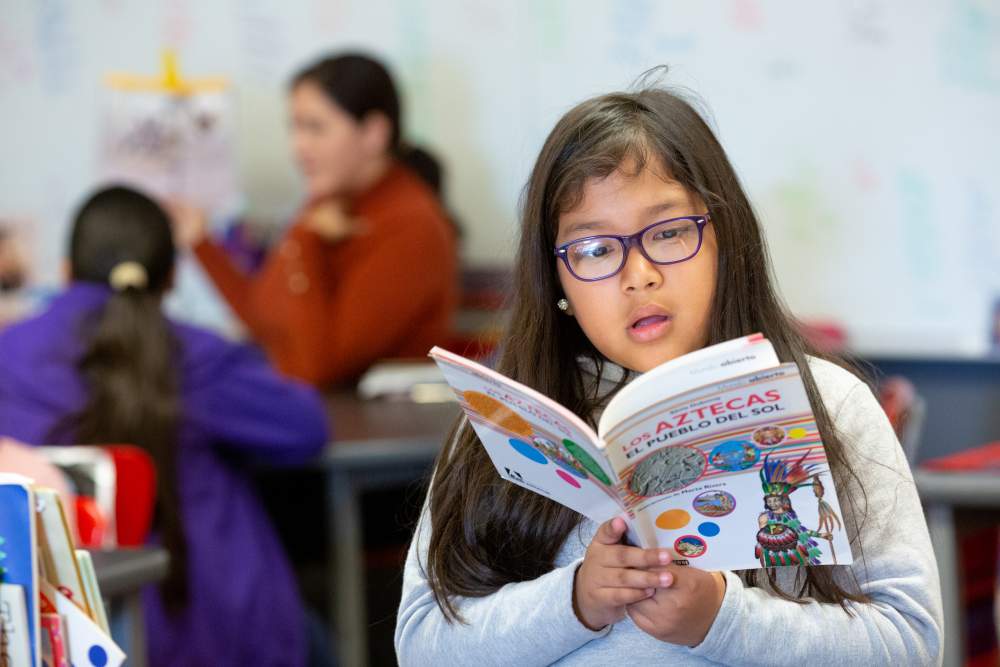
Texas educates one of the largest populations of bilingual students in the nation, with 1.3 million students, and 85.7% of bilingual students who speak Spanish. Across the state, bilingual and dual language programs are built on a shared promise: that students will develop strong literacy, academic knowledge and confidence in more than one language. Fulfilling that promise depends, in large part, on the quality of the Spanish-language texts students encounter every day.
In 2026, the Texas Education Agency proposed a required K-12 reading list to implement across Texas public schools under House Bill 1605. The list of texts includes fairy tales and foundational U.S. history texts. The list also includes English to Spanish versions for Spanish-speaking students.
Literature in Spanish needs to be more than a mere companion or mirror of English instruction. In high-quality bilingual and dual-language classrooms, it is a central pathway for learning, thinking, and expressing complex ideas. Research from the English Learners Success Forum (ELSF) makes clear that materials matter and that Spanish-language arts materials must be intentionally designed to honor Spanish as a language of learning in its own right.
Authentic Spanish-language literature, or texts originally written in Spanish, plays a unique and irreplaceable role in this work. These texts reflect histories, cultures and ways of seeing the world that resonate with many Texas students and families. While translations can support access and cross-language connections, they cannot substitute for literature that reflects the grammatical structures, discourse patterns and literary traditions of the Spanish-speaking world. The ELSF Spanish Language Arts Benchmarks of Quality emphasize that strong materials should reflect how Spanish actually works, sounds and conveys meaning across genres and contexts.
For bilingual students, access to grade-level rigor in Spanish is essential. Authentic Spanish-language texts allow students to analyze theme, character development, text structure and the author’s craft through Spanish, and not through English conventions carried over by translation. When Spanish materials rely heavily on English-based structures or simplified language, students lose opportunities to engage deeply with content and to develop advanced literacy skills in Spanish.
Let’s briefly examine “Don Quixote,” one of the best-known works in all of Spanish literature. Miguel de Cervantes’ original 1605 novel immediately provides historical and social context for its story and characters with its opening lines: “En un lugar de la Mancha, de cuyo nombre no quiero acordarme, no ha mucho tiempo que vivía un hidalgo de los de lanza en astillero, adarga antigua, rocín flaco y galgo corredor.” The word “hidalgo” is a precise term for a lower-tier Spanish noble, while an “adarga” is a particular type of leather shield tied to Iberian history.
In Edith Grossman’s English-language translation of Cervantes’ masterpiece, the opening becomes, “Somewhere in La Mancha, in a place whose name I do not care to remember…a gentleman lived not long ago…one of those who has a lance and ancient shield on a shelf and keeps a skinny nag and a greyhound for racing.” The word “hidalgo” has been softened into the more general “gentleman,” and “adarga” is simplified to “ancient shield” to support reader comprehension. While the translation communicates the general idea, these choices show how cultural nuance, historical specificity, and linguistic texture present in the original Spanish can be partially lost or reshaped when adapted for English-speaking audiences.
Language development is also at the heart of this issue. Because Spanish has a more consistent sound and writing system, students are often able to learn how to read and decode words more quickly in Spanish than in English. While English spelling patterns are more complex and less predictable, the decoding skills students develop in Spanish can support their early literacy development in English. Similarly, when students develop academic language in Spanish, they can transfer their ability to work with complex ideas and language structures to English.
Texts and other materials written originally in Spanish also expose students to complex sentence structures, genre-specific language and discourse styles that translations often flatten or adapt to English norms. According to Spanish Language Arts Benchmarks, high-quality materials embed oral language, reading, and writing in ways that intentionally build Spanish from foundational skills through advanced literacy. Strengthening students’ authentic Spanish literacy skills reinforces their acquisition and development of English language and literacy.
Equally important is the role of literature in affirming students’ backgrounds. Parity between English and Spanish is not only about instructional time, but also about status, where treating Spanish as a legitimate language for constructing and sharing knowledge, rather than as a translated version of English ideas.
When students consistently encounter Spanish through original texts, they receive a powerful message: their language carries intellectual weight and belongs in academic spaces.
This is especially critical in bilingual and dual language programs, where balance across languages is foundational. These programs are designed to cultivate biliteracy, not to position Spanish as a bridge to English. Instead, Spanish becomes a parallel and equally rigorous pathway. ELSF’s Benchmarks call for materials that include Spanish-language varieties, reflect U.S. bilingual students’ linguistic backgrounds, and create opportunities for students to use Spanish for a range of academic purposes.
Translations still have a place. They can support shared learning experiences and strategic cross-linguistic connections. But translations should be used intentionally and judiciously, not as the primary representation of Spanish literacy. A strong Spanish-language literature collection includes a meaningful number of texts originally written in Spanish, spanning literary and informational genres and representing diversified voices from across the Spanish-speaking world.
The list of approved materials has not been finalized; the measure of adoption will be voted on with possible Texas State Board of Education (SBOE) adoption in spring 2026. Implementation will take time; publishers must update materials, with full implementation planned for the 2030 school year. Parents and educators can still ask for texts that align with authentic Spanish literature.
Texas has invested deeply in bilingual education and the goal of biliteracy. Aligning instructional materials to that vision means ensuring that Spanish instruction reflects the same expectations for rigor, authenticity, and intellectual engagement that we demand in English. Providing students with authentic Spanish literature is not a symbolic gesture; it is a concrete instructional decision that shapes language development, academic growth and students’ sense of belonging.
If we want students to become truly bilingual and biliterate, they must experience Spanish as a language of original thought, analysis and expression. Literature that is organically and authentically in Spanish — instead of translated —makes that possible. It also brings Texas one step closer to fulfilling the promise of bilingual education.
Contact us to learn how we can help you improve academic outcomes for your emergent bilinguals.

