How To Drive Dual Language Success With High-Quality Spanish Language Arts Materials

Across the nation, states report almost a million English learners enrolled in bilingual or dual language immersion programs; that number continues to rise. District leaders seek materials with a strong Spanish Language Arts (SLA) component, as the videos below show. Yet many face a persistent challenge: a lack of clarity on what constitutes true SLA quality and a lack of viable options. By expanding the limited understanding of the full academic benefits of quality SLA programs, we hope to make the case for demanding, identifying and choosing better SLA materials.
High-quality SLA materials are not a niche request. It is a necessity, just as important as high-quality ELA materials. Yes, we need culturally responsive materials to foster positive identity development. Research shows that authentic, high-quality SLA materials do more than honor cultural identity. They accelerate literacy development in both Spanish and English, thus enhancing overall academic achievement.
In this piece, ELSF provides district leaders with three clear steps to ensure dual language Spanish programs have the quality materials they need.
Step 1: Understand What Quality Looks like. Understand SLA quality indicators. We will outline research-backed indicators needed to evaluate SLA materials effectively.
Step 2: Empower SLA Experts. Appoint dedicated Spanish experts who understand quality indicators on curriculum review committees.
Step 3: Act on the Expertise. Listen to the recommendations from your SLA experts and make decisions based on research and expert guidance.
Know the Benchmarks of Quality
ELSF’s Benchmarks of Quality are research-backed review criteria, or quality indicators, that outline critical features and supports for effective high-quality materials that address the assets and needs of multilingual learners. They were created in collaboration with researchers and practitioners and based on years of research of what works for MLLs.
ELSF’s Benchmarks of Quality for Spanish Language Arts Materials
- Honor the Spanish Language: Use authentic texts by Spanish-speaking authors that reflect the grammar, styles, and literary traditions of the Spanish language.
- Provide Spanish Literacy from Foundational to Advanced: Embed oral activities, follow the sounds and structures of Spanish, and use complex texts as models.
- Utilize Students’ Linguistic Backgrounds: Respect bilingual Spanish, scaffold language use, and explore Spanish varieties and translanguaging.
- Ensure Sociocultural and Linguistic Hybridity: Compare English and Spanish across all linguistic levels, build metalinguistic awareness, and include U.S. Latine hybrid identities.
- Provide Linguistically Inclusive Assessments: Assess language and content based on Spanish objectives, using formative, authentic and multi-skill methods
When students receive skillful instruction working with materials that meet these benchmarks, their literacy skills grow in both languages. Some specific benefits:
Reading authentic Spanish texts builds transferable literacy skills in English
Too often, SLA materials rely on translations that use artificial and inaccurate Spanish. High-quality SLA materials feature culturally responsive, rich texts originally authored by native speakers across Spanish-speaking regions (including the U.S.) (benchmark 1). For example, García Lorca's "Mariposa del Aire" introduces critical multisyllabic vocabulary like mariposa, hermosa, and dorada, while authentic scientific texts use complex syntax: “Los barcos y las hélices pueden lastimar a las ballenas causándoles cortes y heridas al chocar con ellas.”
By nature, Spanish uses longer, more complex sentence structures than English. Children encounter this rich syntax through traditional word play and songs like "Un elefante se balanceaba sobre la tela de una araña". These early experiences are foundational in understanding scientific prose like “Un viento constante y tranquilo es importante para que se forme un huracán.” Such authentic texts—even those written for children—preserve the diverse discourse styles and rich vocabulary of various Spanish-speaking cultures.
High-quality SLA materials pair complex, authentic text with strategic teacher guidance. Working through complex sentence structures builds sentence-structure awareness in Spanish, which accelerates reading comprehension and literacy acquisition in English.
Developing foundational literacy skills in Spanish improves decoding and fluency in English
Developing strong literacy skills in Spanish provides Spanish-speaking multilingual learners with a foundation they can build on as they learn to read in English. Rather than developing literacy for the first time while simultaneously learning English, students can transfer established literacy skills and understandings and use them to support English-specific decoding and fluency.
Because Spanish spelling is highly consistent, sounding out and spelling unfamiliar words is highly predictable. By structure, Spanish features mostly multisyllable words (such as “tortilla” or “manzana”), so children encounter these words in speech and reading early on.
High-quality Spanish materials focus on breaking words into syllables rather than individual sounds. Consider the sentence “Mira la luna” (Look at the moon). With effective teacher guidance, students focus on separating syllables (“lu/na”), not just on identifying isolated sounds (“a”). This approachable structure builds a bridge to English's more complex spelling system, ultimately improving student achievement across both languages.
Developing language awareness increases literacy achievement in both languages
High-quality SLA materials promote students’ language awareness (thinking and reflecting on how language works) and cross-linguistic connections, which improve literacy achievement in both languages (benchmark 4).
Students are systematically prompted to compare and contrast both languages across sounds, word parts, and sentence structures to build language awareness. Yes, they identify cognates like invisible/invisible and elefante/elephant, or shared morphemes like “in-.” They also analyze structural differences in dependent clauses. For example, teachers might prompt students to contrast the sentence pattern of: “Un viento constante y tranquilo es importante para que se forme un huracán” versus “If there is enough warm water to feed the storm, a hurricane forms.”
This language awareness helps students develop both languages and promotes their critical thinking by transforming passive communication into active intellectual inquiry. Reflecting on the similarities and differences between Spanish and English helps them see language as a system with underlying structure, rules, and intent. Analyzing both languages side by side deepens students' biliteracy and expands their overall problem-solving and reasoning skills.
Taking Action: How District Leaders Can Drive SLA Quality
Empowering students begins with informed leadership. To ensure your dual language programs deliver on their promise, district leaders must take concrete internal steps to commit to high-quality SLA materials, while also joining a broader national movement to demand a greater supply of SLA materials.
District decision-makers must commit to seeking Language Arts materials with a high-quality Spanish component. First, we must align on quality. Then, we must embrace and articulate the myriad benefits for students, including their literacy development in both Spanish and English, and their overall academic achievement.
Step 1: Understand What Quality SLA Looks Like. Before reviewing vendor submissions, study ELSF’s five SLA Benchmarks of Quality to recognize rigorous, non-translated materials.
- Do not assume that high-quality authentic Spanish texts for children are unavailable.
- Do not assume that high-quality English materials guarantee a high-quality Spanish equivalent.
- Do not ignore flaws in the Spanish materials simply to expedite a standard ELA purchase.
Step 2: Empower SLA Experts. Identify and appoint individuals to curriculum review committees who have both a deep, native-level expertise in Spanish Language Arts and an understanding of quality indicators.
- Do not evaluate Spanish material through English-centric frameworks.
- Do not rush materials review without having experts at the table.
- Do not performatively appoint experts and then dismiss their recommendations.
Step 3: Act on Expertise. Just as important as implementing your Spanish-knowledgeable reviewers’ findings is making decisions based on research and expert guidance.
- Do not settle for subpar materials. Make informed decisions based on research.
- Download ELSF’s Benchmarks of Quality placement
- If you find your materials are subpar, download ELSF’s If/Then Guide to help make better decisions.
Signal Market Demand in California
For District leaders in California, your opportunity to make critical decisions around quality SLA materials is NOW. California is entering the pivotal 2026 ELA/ELD/SLA instructional materials follow-up adoption process, with the California State Board of Education scheduled to finalize its considerations in November.
Publishers have historically neglected developing high-quality Spanish Language Arts (SLA) materials. Instead, the market is saturated with flawed, low-quality translations or watered-down Spanish versions of English.
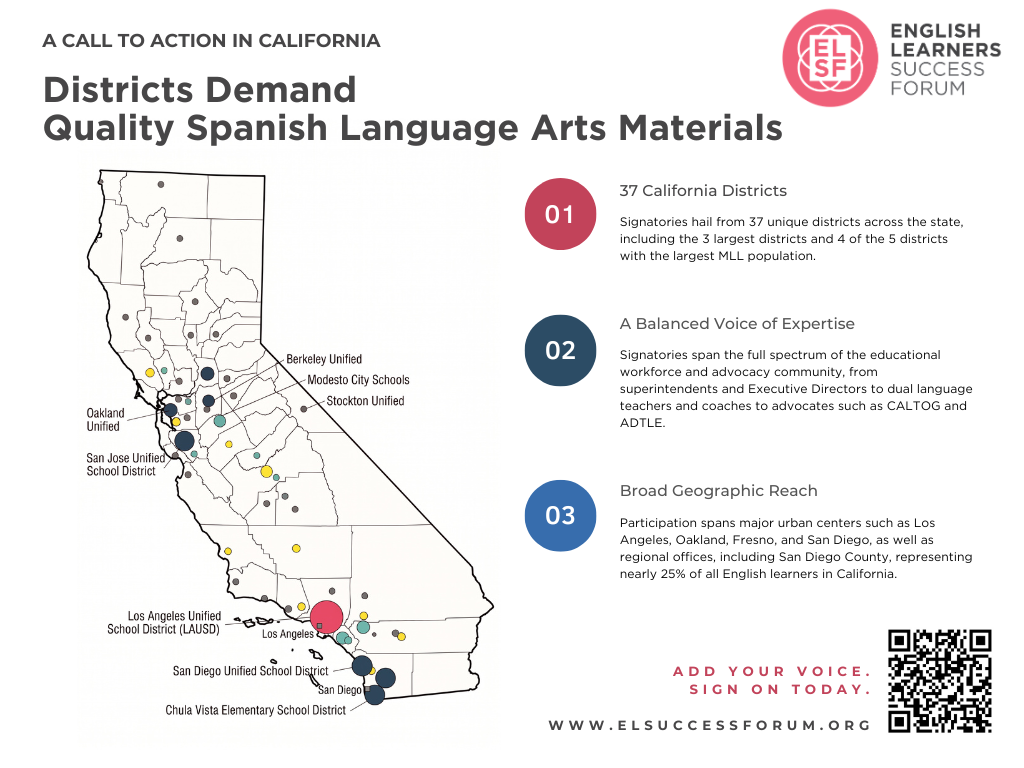
To ensure parity between English- and Spanish-language materials for multilingual learners, ELSF collaborated with prominent education leaders from Fresno, Oakland, and San Diego. Together, they issued a joint statement demanding that publishers prioritize rigorous, authentic, and research-aligned SLA instructional materials. The statewide call to action, “Alerta: Demand High-quality Spanish Language Arts (SLA) materials,” calls on publishers to treat Spanish as a primary language of instruction rather than as a Spanish version of English.
By signing the statement, CA district leaders use their voice to demonstrate demand across California and drive momentum to increase the demand, and thus supply, of high-quality SLA materials. Add your voice to the statement.