
Adoption as a Vehicle for Change: A Story from Orange County Department of Education

As the Orange County Department of Education (OCDE) prepared for its upcoming math curriculum adoption, leaders paused to ask a deeper question: how could this moment serve as a catalyst for stronger, more equitable instruction for ALL learners, specifically multilingual learners and students with disabilities?
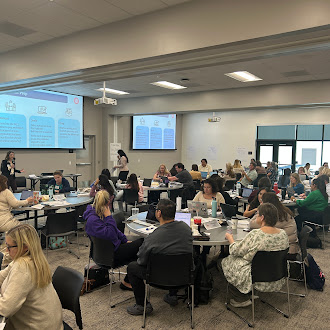
With one in five students identified as English learners, OCDE recognized that multilingual learners must be central to adoption decisions, not an afterthought. To support this vision, OCDE partnered with ELSF to help district leaders hone their ability to identify MLL-inclusive supports in materials and to leverage that lens during their materials adoption process. OCDE used ELSF’s research-based tools to guide adoption decisions and, in January, hosted an ELSF-led workshop for more than 50 district leaders.
The workshop received overwhelmingly positive feedback from all participants, with 100% reporting that the session met its intended goal and was integral to their work on math curriculum adoption in their districts.
In addition, 100% of participants also said that:
- The workshop helped them understand why the “Math Must-Haves” are essential for all learners and critical for multilingual learners.
- The workshop increased their confidence in identifying the “Math Must-Haves” in math materials.
- They plan to advocate for the Multilingual Learner Review Criteria when engaging with math publishers and/or district leaders to support math adoption in their district.
In the Q&A below, one of OCDE’s math coordinators, Vanessa Cerrahoglu, reflects on what this partnership has made possible, why centering multilingual learners early in the adoption process matters, and what emerged from OCDE's approach that others might find helpful.
Vanessa is one part of a team of educators who strive to empower K-12 students through rich mathematical experiences. Other members of the team include Katie Beck, STEM Coordinator; Julie Heimer, STEM Coordinator; Stephanie Marvicsin, Mathematics Coordinator; Janie Yoo (Janny Kim), Mathematics Coordinator; John Fox, Program Specialist; Joyce Beynon, Administrative Assistant; and Jennifer Hughes, Administrative Assistant. The team’s charge is to support districts in developing a mathematically literate society by studying, understanding, and fostering practices grounded in research to improve math teaching and learning.
Q: Taking a step back, why is the focus on multilingual learners in Orange County important? What are you hoping to achieve?
About one in five of our students are English learners, and they deserve materials that honor who they are and give them full access to rigorous math.
As a multilingual learner myself, I know there is real beauty in finding ways to communicate when there is no common language — this calls for respect for the ideas and experiences that multilingual learners bring, while ensuring they have full access to grade-level content in order to build the knowledge and skills they need to achieve their dreams.
At the heart of it, serving multilingual learners and serving all students aren't separate goals — they're one and the same. Through this work, our team needs to practice what we're asking of districts: work across roles and disciplines in ways that invite reflection, alignment, and flexibility. It begins by building relationships, opening lines of communication, and looking for ways to build on each of our strengths — we each bring valuable insight, perspective, and knowledge.
The ELSF criteria and partnership gave our districts a powerful lens to move beyond "Which book?" to "What student experience are we building together?" That shift, from selecting materials to building systems, is what we believe will create lasting change for multilingual learners and all students in Orange County.
Q: Your team's full-system approach is unique. Can you talk about how the team is doing that and why?
A: This work is SO big.
A couple of years ago, we began by asking: What does it look like when students experience equitable and engaging instruction in every classroom? We worked backward from there. If that's the student experience we want, what needs to be true for teachers? For teacher collaboration? For district support? That backward mapping became the foundation for everything.
Our team’s focus was to foster recognition that curricular materials adoption isn't just about choosing a textbook. We worked in partnership with Dr. Vinci Daro and Dr. Jack Dieckmann to create a network space where districts could learn with and from one another. It's an opportunity to reflect on the district vision for students, coordinate efforts across the system, and build the supports that will actually make that vision real in classrooms.
Leveraging the adoption process became central to our work with districts. When teams slowed down to do the foundational work of building a vision, they recognized that every curriculum requires time, collaboration, and intentional support. The adoption process became their opportunity to refine systems, not just select materials.
Q: How are you working with those teams that decided to slow it down and have not adopted materials yet?
A: We built a year-long overarching storyline for our “Orange County Math Leads- Vision Driven Math” (OCML-VDM) Network. We structured each session with three parts: shared learning, PLC time, and a “choose-your-own-adventure” segment. As our coordinators partner closely with specific districts, we’ve gained deeper insight into the complexity of adoption work. Learning has become an accordion—insights flowing within and beyond the network—and that dynamic exchange has been powerful.
One district shared a cautionary tale. Another came seeking input on its pilot process. A third outlined a multi-year plan to build an articulated vision. Our VDM space fosters connections so districts can see and learn from each other. That cross-pollination generates new possibilities and ways of thinking that none of us would have reached on our own.
This year, we’ve continued iterating on adoption processes while transitioning toward curriculum-based professional learning, building a shared understanding of what strong implementation could look like in the coming years.
Throughout, we returned to one core idea: high-quality instructional materials are one essential component in ensuring every student develops the knowledge and skills to realize their dreams. Our goal is to create the conditions for districts to engage in this work collectively.
Q: Tell us about your commitment to multilingual learners and how you’re moving that forward with math instruction?
A: This commitment started some time ago when I partnered with former OCDE colleague, Richard Romero, then Literacy & Language Program Specialist, to offer districts professional learning opportunities grounded in UL/SCALE’s Math Language Routines, the English Learner Roadmap, California Math Standards, and ELD Standards. That work evolved through multiple iterations and expanded into several partnerships, including with Dr. Jeff Zwiers, Dr. Vinci Daro, Dr. Jack Dieckmann, and Jeremiah Lack, Curriculum Specialist at Colton USD.
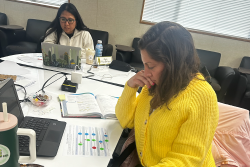
The common thread was inviting districts to attend as multi-role teams: classroom educators, Math TOSAs, ELD Specialists, and site leaders. For many districts, it was the first time colleagues across roles learned and worked together. Through that collaboration, we realized we were asking teams to retrofit existing curricular materials to create equitable, engaging experiences for multilingual learners.
As the 2023 California Mathematics Framework moved through adoption, our math team saw the opportunity: leverage the upcoming materials adoption to help districts begin with high-quality instructional materials from the start. After engaging with the work emerging from Cal Curriculum and ELSF’s development of the Multilingual Learner Review Criteria, we felt compelled to share with districts a way to examine materials through an English language development lens.
Q: Tell us about the instructional materials fair.
A: Our teammate John Fox took the lead in organizing an instructional materials fair this winter– a space where districts could engage directly with publishers and explore materials hands-on. The fair came at a time that had been almost two years in the making. Districts had been attending VDM and building their lens for what to look for in materials. Our partnership with ELSF was one more opportunity for districts to prepare to engage with publishers in meaningful ways.
Part of the preparation work involved asking any publisher who wanted to participate in the fair to submit a self-report analyzing their materials against the Multilingual Learner Review Criteria. We now have at least 60 reports using the criteria. Some publishers reported against all five criteria, while others focused on the two we selected. One publisher submitted a 100-page report! Now every OC district has this information at its fingertips.
It is important to note that these are publishers’ self-reported findings. That's where our partnership with ELSF comes in. By engaging district teams in a deep dive of the criteria and curricular must-haves, districts are now positioned to confirm or refute reporting. It's complex work, but worthwhile. We anticipate this process will lead to the adoption of high-quality instructional materials that truly serve all students.
Q: What would you tell other districts that are going through this adoption process, particularly, those that want to support multilingual learners but don’t know where to start?
A: I would start with questions, because it’s a complex answer, and you need to understand where you’re at. I would ask them, ‘What do you know about your students? What do they want? What are they hungry for? How is your system set up to provide that? And then, what role will textbooks play in that?’
Many of the districts we work with land on the idea that you have to go slow to go fast. You have to be purposeful and intentional, starting with relationships and opening lines of communication across roles. A well-orchestrated adoption process can be the vehicle for an ongoing collective effort — one that builds on everyone's strengths, keeps your vision for students at the center, and creates the systems to make that vision real in every classroom.
------
Download ELSF resources to support math materials adoption that are inclusive of MLLs.
- Materials Must Have Infographic: A visual to help explain why it is important to identify materials that are high quality and inclusive of MLLs.
- Math Adoption Toolkit: Overview: For education leaders looking for a deeper dive into tools to support their math adoption process to ensure it is inclusive of MLLs.
- RFP Language for Math Instructional Materials: Language that you can copy to include in your RFP to curriculum developers to let them know you expect their materials to be inclusive of MLLs.
Please contact ELSF CA Director Dr. Alma Castro at acastro@elsuccessforum.org for any questions or additional information about how ELSF can help you improve academic outcomes for your multilingual learners.
